Industrial Epoxy Flooring in Duval County
Heavy-duty, chemical- and salt-resistant floor systems for the warehouses, distribution centers, and processing plants that power Jacksonville's port economy.
Industrial Floors Built for a Port City on the Water
Jacksonville runs on freight and the water. Cargo moving through JAXPORT terminals on Blount Island, Dames Point, and Talleyrand feeds a dense ring of distribution centers, cold-storage buildings, and light-manufacturing plants across Duval County — much of it clustered along the I-95, I-10, and I-295 beltway and out toward Westside, Northside, and the Cecil Commerce Center. Those floors take a beating that a standard commercial epoxy floor isn't built to survive: nonstop forklift turns, loaded pallet jacks, container handling, and the constant moisture that comes with operating in Northeast Florida.
Two things about this city make industrial slabs harder to coat than almost anywhere inland. First, the water table sits shallow — much of the metro is barely above sea level along the St. Johns River and the tidal creeks that feed it, so vapor pressure pushes up through warehouse slabs year-round. Second, Atlantic salt air carried in off the beaches and through the river basin works its way into loading docks, open bays, and dock-high doors, accelerating corrosion and surface breakdown. A coating that ignores either one fails early, no matter how heavy-duty the resin.
We engineer each system to the building's job: vapor-tolerant primers and moisture barriers under warehouse and distribution floors, chemical-resistant coatings for processing and washdown areas, salt- and corrosion-resistant finishes for dock-side and waterfront bays, and high-traction surfaces for maintenance shops. Every install starts with full-slab moisture testing, because in Jacksonville's humidity and shallow water table, trapped vapor is the number-one reason industrial coatings delaminate.
Running a retail, office, or hospitality space instead? See our commercial epoxy flooring service.
What a Jacksonville Industrial Floor Has to Survive
Built for the realities of a coastal port economy — moisture from below, salt air from the river, and round-the-clock traffic above.
100+
Chemical & Salt Resistant
Stands up to acids, alkalis, solvents, oils, fuels, and the chloride-laden salt air that drifts in off the Atlantic and the St. Johns. We match standard or novolac epoxy systems to whatever your Jacksonville facility actually handles — from fuel and hydraulic fluids in a maintenance bay to wash chemicals in a food plant.
10,000+ lbs
Forklift & Container Traffic Rated
Holds up to the grind of a freight operation — forklifts pivoting at dock doors, loaded pallet jacks, and the point loads of racked inventory — without cracking, chipping, or peeling. Sized for the 24/7 throughput of Jacksonville's distribution and logistics floors.
OSHA
OSHA Safety Compliant
Anti-skid aggregates, high-visibility lane colors, and non-slip textures that meet or exceed OSHA slip-resistance standards — and stay safe even when humid air and tracked-in rain leave a wet film on the floor. Critical in a climate where summer storms roll through almost daily.
Custom
Safety Line Marking
Forklift lanes, pedestrian walkways, staging zones, dock-door approaches, and emergency egress paths laid out to keep a busy freight floor moving safely. Color-coded and applied in durable epoxy that won't scuff away under container and pallet-jack traffic.
ESD
Anti-Static (ESD) Options
Conductive and dissipative ESD floors for electronics assembly, defense and aerospace contractors supporting the area's Navy installations, and anywhere flammable vapors or sensitive components are present. Built to ANSI/ESD S20.20 for controlled environments.
10–20 yrs
Years of Service in a Coastal Climate
When the slab is prepped right and the moisture is managed first, an industrial floor in Northeast Florida's heat, humidity, and salt exposure keeps performing for a decade or more under heavy traffic and chemical use. Doing the prep wrong is what cuts that short — which is why we never skip it.
How humidity affects durability →Our Install Process
Five steps from bare slab to a cured, production-ready floor — with the moisture work that a building near the St. Johns River genuinely needs. We can phase the install so your dock keeps running.
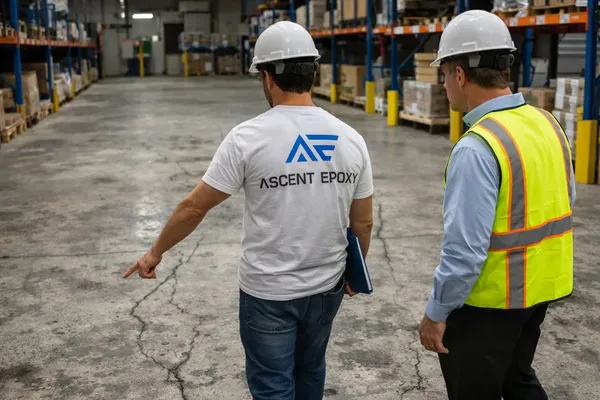
Facility Assessment
~Half dayWe walk the building, run moisture tests in several zones — non-negotiable this close to the river and the coast — note what chemicals and washdown the floor sees, trace your forklift and foot-traffic paths, and flag existing slab damage. Schedule yours free.
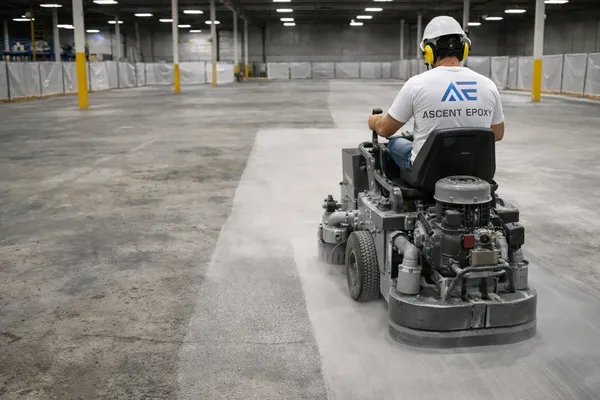
Industrial Slab Preparation
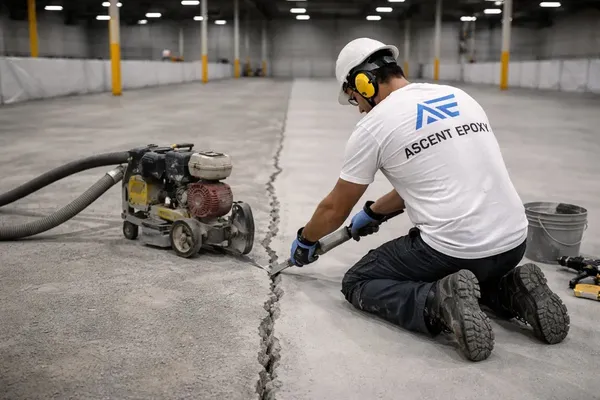
4–8 hrsWe shot-blast and diamond-grind the whole slab to open the concrete and lock in a mechanical bond — the only profile that holds up under container weight and salt exposure. Large freight floors get the extra hours they need so nothing is skipped, and every crack, control joint, and gouge is repaired first.
Primer & Moisture Barrier
2–4 hrsThis is the step that makes or breaks a Jacksonville floor. A vapor-tolerant industrial primer seals the slab and chemically bonds the concrete to the epoxy above it. Where the moisture readings come back high — common on slabs sitting near the water table — we lay down a full vapor-barrier coating so rising moisture can't blister the finish later.
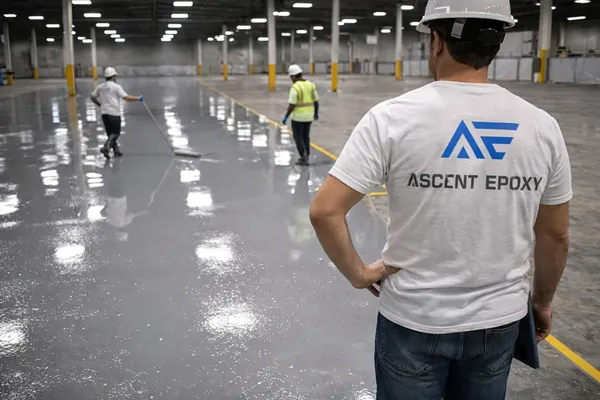
Epoxy System Application
1–3 daysWe build up the floor in coats, choosing the chemical-resistant, impact-rated, salt-resistant, or ESD formulation your operation calls for. Forklift lanes, color-coded zones, and anti-slip aggregate go in during this phase — so the safety layout is part of the floor, not painted on after.
Curing & Handoff
3–7 daysThe floor cures under monitored temperature and humidity — which matters in a climate where ambient moisture can stall a cure. We check hardness, adhesion, and chemical resistance before we hand it over, and your crew gets care instructions written for your exact system and building.
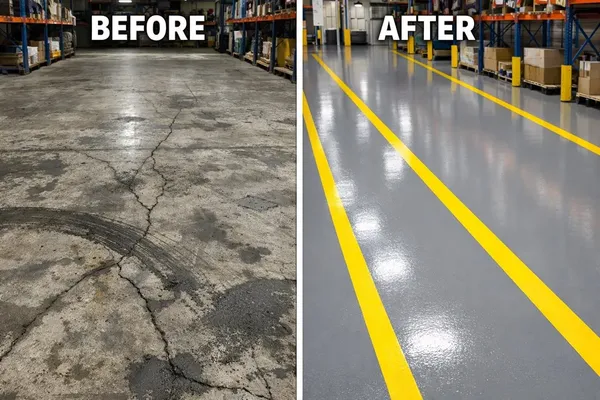
Ready to Start? Step 1 Is Free.
Schedule your no-obligation consultation and see finish samples in your space.
Industrial Epoxy Projects
Floors we've put down in Jacksonville-area warehouses, shops, and processing facilities.
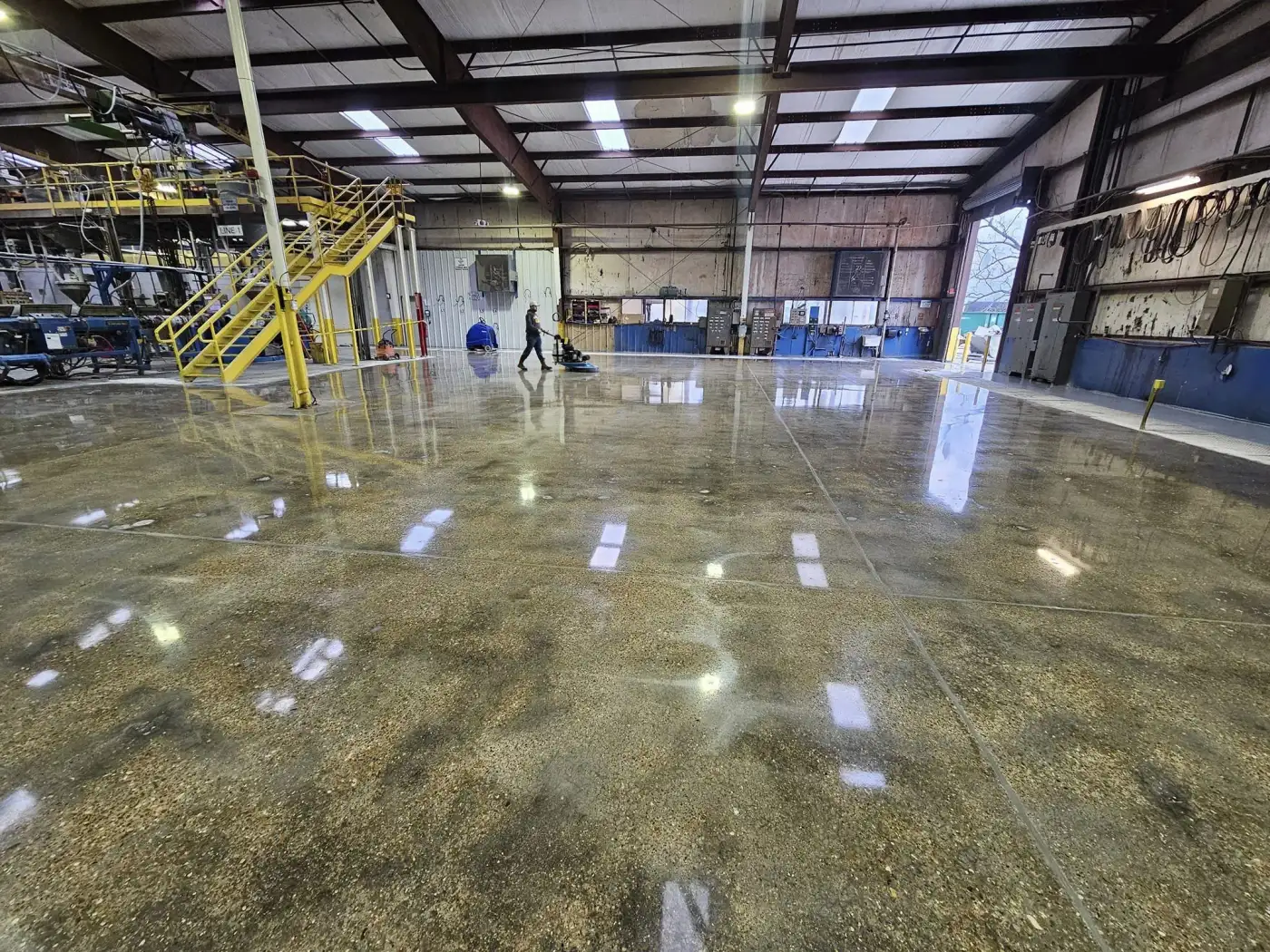
Systems We Build for Jacksonville Facilities
A logistics-and-port economy runs on a handful of floor types. Here are the ones we install most across Duval County — matched to the building, not pulled off a shelf.
Urethane Cement for Food & Beverage Floors
Jacksonville's seafood houses, beverage bottlers, cold-storage buildings, and food-processing plants put their floors through cycles that destroy ordinary epoxy: daily hot-water washdowns, caustic sanitizers, and the temperature swing between a freezer dock and a wet processing room. Urethane cement is the answer — it bonds into the slab and shrugs off thermal shock, steam cleaning, and standing moisture.
It's also the system we reach for in wet or heavily loaded production areas anywhere humidity and constant cleaning would lift a thinner coating. Urethane cement cures fast and is back in service within about 24 hours, so a plant can wash down at night and be running the next shift — and it can be finished with an anti-microbial, slip-resistant surface where food-safety codes require it.
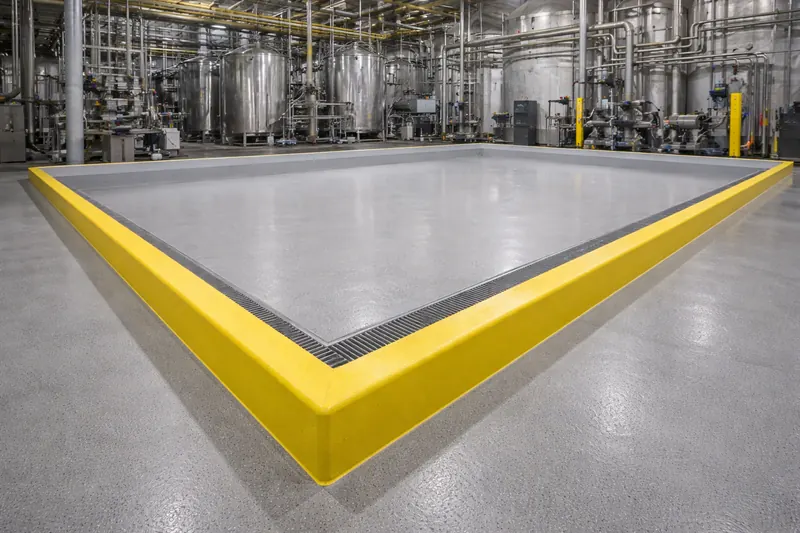
Warehouse & Distribution Floors
This is the workhorse floor of a port town. Cargo coming off JAXPORT moves into distribution and fulfillment buildings where forklifts pivot in the same spots all day, pallet jacks drag loaded skids, and racking drives thousands of pounds onto small footings. Left bare in Jacksonville's humidity, a slab dusts, cracks, and breaks down faster than most operations managers expect — and the moisture pushing up from below only speeds it along.
We coat these floors with high-build epoxy and an abrasion-resistant topcoat tuned for forklift wear, over a vapor-managed base so the finish stays bonded. Lane striping, aisle markings, pedestrian zones, and dock-door color coding go in as part of the system. And because a working distribution center can't just shut down, we phase the install around your shifts and outbound schedule to keep product moving.
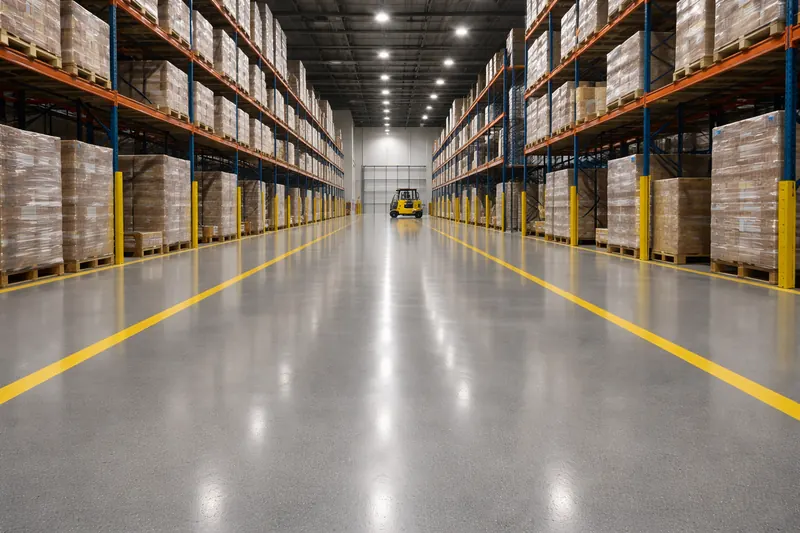
Secondary Containment Areas
A river port moves a lot of fuel, oil, and bulk chemical product, and any Jacksonville facility that stores or transfers it carries secondary-containment obligations. With the St. Johns River and its tidal creeks draining straight to the Atlantic, keeping a spill out of the ground and the storm system isn't just an EPA and OSHA box to check — it protects the waterway the whole region depends on.
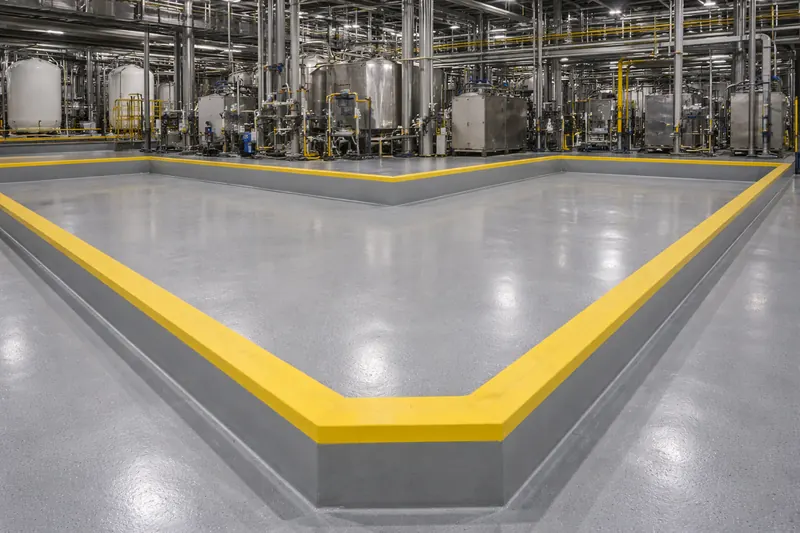
We install chemical-resistant containment coatings with integrated curbing and berm systems that pen a spill in before it reaches a drain or the soil. The basins are built to hold 110% of the largest container's volume to meet federal and Florida requirements, and the coatings resist a broad range of substances — acids, bases, fuels, and organic solvents alike.
Rated 4.9★ — Duval County Reviews
Real reviews from real Duval County clients — verified on Google.
"Had my garage floor done by Ascent Epoxy Jacksonville this summer. The crew showed up on time, worked clean, and the finish turned out perfect, smooth, glossy, and tough. No more dust or oil stains. Even with all the car traffic, it still looks new. Easily one of the best upgrades I have done to the house."
"Great experience from start to finish. They explained everything clearly and my shop floor looks amazing now. Definitely recommend."
"I chose Ascent Epoxy because of their great evaluations and experience. They did not disappoint us!"
Industrial Epoxy Flooring FAQs — Duval County
Common questions about industrial epoxy flooring for Duval County facilities.
We install industrial epoxy flooring in a wide range of facilities across the Duval County metro area, including:
- Warehouses and distribution centers
- Manufacturing plants
- Chemical processing facilities
- Food and beverage processing plants
- Maintenance bays and service shops
- Control rooms and clean environments
Our systems are engineered to handle the specific demands of each facility type, from chemical resistance in processing plants to impact resistance in high-traffic warehouses.
Duval County's average 74% humidity is critical for large industrial slabs. Moisture trapped beneath the coating causes delamination and peeling, and on expansive warehouse floors, even small moisture variations can affect thousands of square feet.
We perform comprehensive moisture testing across the entire slab using calcium chloride and relative humidity probe methods. When readings are elevated, we apply moisture-mitigating primers and vapor barrier coatings before the epoxy system goes down. We also schedule installation windows around optimal humidity conditions to ensure a lasting bond.
Yes. Our industrial epoxy systems are formulated with chemical-resistant resins that withstand exposure to a wide range of substances, including acids, alkalis, solvents, petroleum products, oils, and fuels.
We offer various chemical resistance ratings depending on the specific chemicals present in your facility. Standard epoxy handles oil, grease, and mild chemicals. For facilities along the petrochemical corridor that deal with concentrated acids and harsh solvents, we install novolac epoxy systems with the highest chemical resistance ratings available.
Yes. We install OSHA-compliant safety line marking as part of our industrial epoxy flooring systems. This includes:
- Pedestrian walkways
- Forklift traffic lanes
- Hazard zones and restricted areas
- Equipment placement boundaries
- Emergency exit paths
- Color-coded area designations
All markings are applied with durable epoxy paint that bonds directly to the floor system and withstands heavy daily traffic without fading or peeling.
Industrial epoxy installation typically takes 3 to 7 days depending on the facility size, condition of the existing concrete slab, and complexity of the coating system required.
For larger facilities, we offer phased installation that allows you to keep portions of your operation running while we work on other sections. This minimizes downtime and keeps your production schedule on track. We provide a detailed project timeline during the estimate phase so you can plan around the installation.