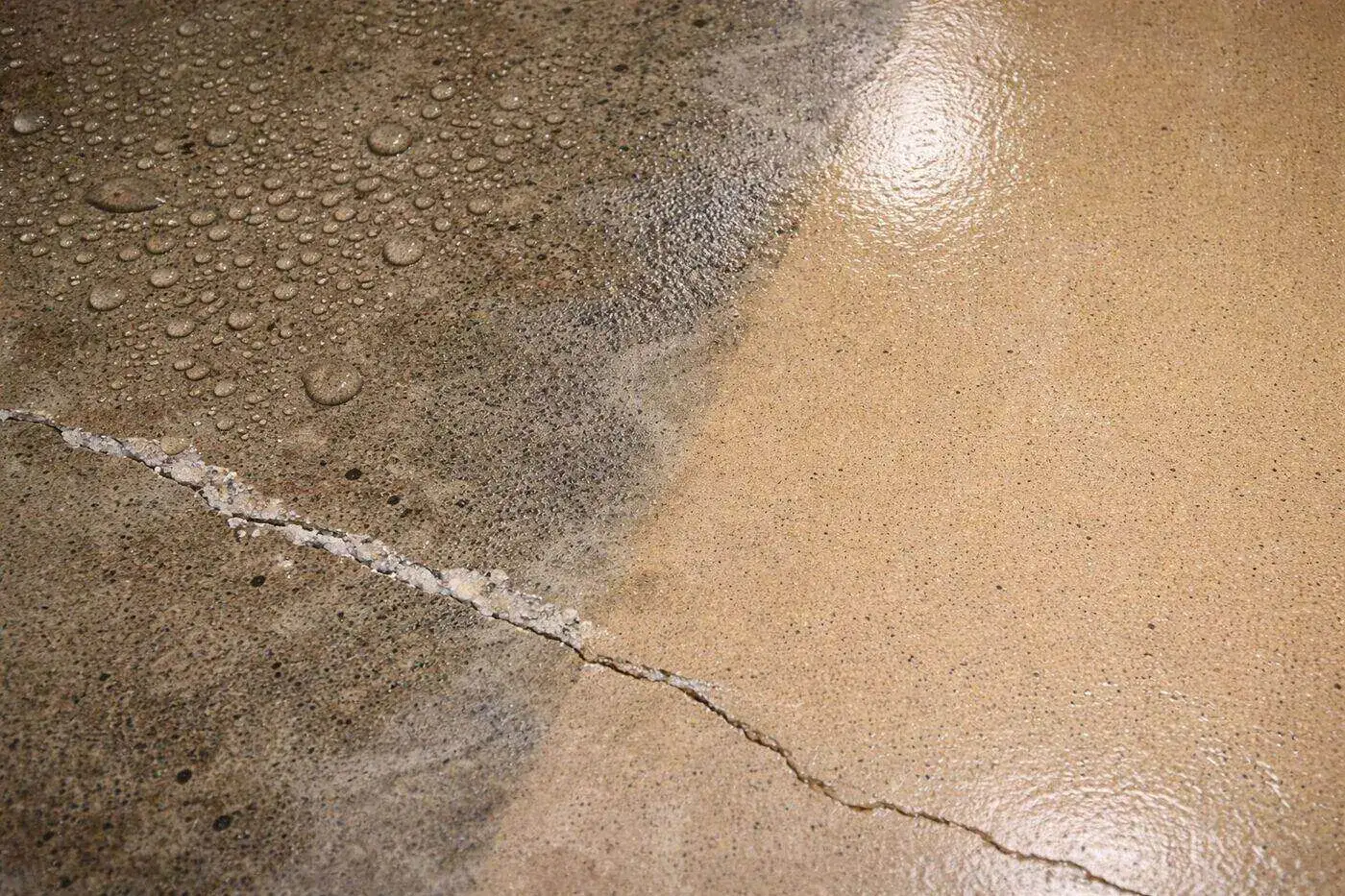
When an epoxy floor lets go in Northeast Florida, the coating is rarely the villain. The slab underneath was wet, nobody measured it, and water vapor did the rest. One step prevents it: read the concrete before you ever pour resin on it.
Picture a new garage coating in Mandarin or out by Jacksonville Beach that looked flawless on install day, then started clouding and lifting before the first real summer storm season passed. The homeowner assumes they got a bad batch, or a sloppy crew. Almost always the actual problem was sitting under the floor the whole time, invisible, moving upward through the slab. It is also the single step a lowball installer quietly leaves out. Below, we walk through why this hits Duval County harder than most of the country, the standardized readings that expose it before any resin is mixed, and the exact questions that tell a careful contractor apart from one who will hand you a peeling floor.
Why Coatings Let Go in Duval County
An epoxy system works by curing into one continuous film that grips bare concrete. That grip only holds if the slab beneath stays dry and settled long enough for the resin to lock down. Trouble starts when groundwater under the slab turns to vapor and migrates up: that rising vapor presses on the back of the coating with genuine force. Give it a few weeks of Northeast Florida humidity and that pressure peels the film off the concrete. You see it as blisters, milky-white haze, edges that curl, and finally whole sections sheeting away.
Coating specialists call this moisture vapor transmission, and it tops the list of reasons epoxy fails early anywhere. No defective resin, no manufacturer error involved. Just a floor that got coated before anyone proved the concrete was dry enough to take it. Here is the maddening part and also the good news: vapor transmission is measurable in advance. Test the slab and you can engineer a system around whatever it reads. Skip the test and you are rolling dice with your driveway-side garage budget.
The Geology Working Against Your Slab
Few places in America punish a careless epoxy install the way Northeast Florida does, and you can blame the ground itself. Duval County rests on loose, sandy coastal soil with a water table sitting unusually high. A huge share of the county — the oceanfront Beaches and Atlantic Beach, the homes hugging the St. Johns River and the Intracoastal, the low subdivisions around Orange Park and Nocatee — sits barely above sea level. Drop down a few feet under many of these slabs and you hit groundwater. That standing reservoir never stops feeding vapor upward through the concrete, every season of the year.
Construction habits make it worse. Plenty of Northeast Florida homes were poured slab-on-grade over thin or already-degraded vapor sheeting, and on older houses whatever barrier existed has long since failed. The net result: groundwater shoving moisture up, and almost nothing in the slab pushing back. That is precisely why vapor mitigation is routine on Duval County jobs instead of the once-in-a-while extra it would be on some dry slab in the interior West.
And this is documented, not hypothetical. Coastal Florida slabs are regularly metered well past the safe vapor ceiling — sometimes so far over that the only honest move is to grind the concrete and lock it down with a vapor-barrier primer before a single decorative coat is trusted. To the naked eye the floor reads bone-dry. The instrument says otherwise, and the instrument is right.
Why 75% Internal Humidity Is the Line
Concrete behaves like a sponge you cannot see into — it carries internal moisture that never shows on the surface. The yardstick the coatings industry trusts is internal relative humidity, taken from inside the slab rather than off the top of it. Reliable epoxy adhesion needs that internal figure under roughly 75 percent. Cross that line and the odds of failure rise fast.
Hitting it is genuinely hard along the First Coast. Ambient air humidity here hovers near 75 percent across the calendar, annual rainfall clears 60 inches, and that perched water table keeps slabs damp from beneath. On top of that, when the air is heavy during the pour, epoxy can throw what crews call amine blush — a greasy, hazy film that means the coating cured wrong and will never bond the way it should. Salt-laden air rolling in off the Atlantic only adds to how aggressive this coastal environment is on a fresh chemical bond. In a climate where the muggy days outnumber the dry ones, that risk is constant.
So a Duval County installer worth hiring does not just check tomorrow's forecast. They probe the slab's internal moisture, evaluate the surface, and time the application to conditions the concrete can genuinely tolerate. Coat a slab reading north of 75 percent and you have laid down a floor that is already on the clock.
Not Sure What Your Slab Is Hiding?
We read the concrete first, then quote. You get a clear number on your slab moisture and a buildup engineered for the First Coast climate.
The Readings That Expose a Wet Slab
None of this comes down to a hunch. ASTM has published standardized procedures that put a real number on how much moisture a slab is releasing, and any contractor who takes Duval County work seriously should run at least one before quoting. Three are worth knowing by name.
Relative Humidity Probe Test (ASTM F2170)
Treat this one as the benchmark. The crew bores small holes, seats sealed probes down inside the slab, and reads the relative humidity deep in the concrete instead of skimming the surface. Since it captures the exact moisture that drives a coating to fail, F2170 is the reading most resin manufacturers cite when they write their warranty terms. Land under about 75 percent internal RH and the slab is clear to coat. Come in higher and mitigation has to happen first — common on the damp slabs near the river and the Beaches.
Calcium Chloride Test (ASTM F1869)
The older approach, this one captures how much moisture escapes the top of the slab over a fixed window, logged as pounds per 1,000 square feet across 24 hours. Three pounds is the line most coatings won't cross. Push past it and vapor pressure is strong enough that delamination odds jump and a vapor barrier stops being optional. Still a legitimate check, though the RH probe has overtaken it as the standard precisely because it looks inside the slab rather than only across its face.
Plastic Sheet Test (ASTM D4263)
Consider this the fast field flag. A square of clear poly gets taped airtight to the concrete and left a full day or longer. Condensation beading on the underside, or the slab darkening where it sat, means vapor is on the move. It is handy for catching an obvious offender quickly, but it is a screen, not a measurement — it cannot replace the two numbered tests above. A floor you are paying real money for deserves a hard reading, not a taped-down plastic square.
| Test | What It Measures | Safe Range |
|---|---|---|
| RH Probe (ASTM F2170) | Internal slab humidity | Below ~75% RH |
| Calcium Chloride (ASTM F1869) | Surface moisture emission | Under 3 lbs / 1,000 sq ft / 24 hrs |
| Plastic Sheet (ASTM D4263) | Visible moisture (screening) | No condensation under sheet |
Turning a Wet Slab Into a Coatable One
A high number is not a verdict that your floor can't be done — it just sets the prep that has to come first. The remedy is a moisture-mitigation primer, also called a vapor-barrier coat. The crew diamond-grinds the slab open so the primer has tooth to grab, then lays down a purpose-built epoxy primer engineered to absorb and shut off rising vapor. That coat seals the concrete and lays a stable platform the decorative system can bond onto without fear of the moisture underneath.
It does add to the ticket — the primer is priced as its own layer over the base build. None of that is padding. It is the gap between a floor that holds for years and one that bubbles before the next round of summer downpours. Across a lot of Duval County slabs it is just what doing the job right requires. Reframed honestly: that primer is not inflating the price, it is what makes a lasting floor achievable at all on a damp coastal slab.
It is also the reason a real local contractor reads the slab before naming a price, never after. Skip the reading and every figure is a guess — and the suspiciously cheap guesses are usually the ones that quietly dropped mitigation. Set two quotes side by side and the marginally higher one that bakes in testing and the right primer almost always wins on lifetime cost.
Questions That Separate the Pros From the Pretenders
Protecting yourself does not require a materials-science degree. It requires putting a handful of pointed questions to every installer and noticing whether the answers are concrete or hand-wavy. Run through these before anyone gets a deposit.
- Are you going to measure my slab's moisture before you price it? You want a flat yes, plus a named method — an F2170 humidity probe or an F1869 calcium chloride test. If the question gets brushed aside, move on.
- At what reading do you say a slab needs mitigation? Someone who knows the trade points to the ~75 percent internal RH ceiling or the 3-pound calcium chloride limit. A shrug here tells you plenty.
- My slab comes back high — then what? The answer you're listening for is grinding plus a vapor-barrier primer, not "it'll probably be fine."
- What's your surface prep? It should be a diamond grind that opens the concrete for a true mechanical bond. An acid etch or a light scuff doesn't cut it on a humid First Coast slab.
- Which topcoat, and is it UV-stable? Unprotected coatings yellow under the Florida sun. A polyaspartic or polyurea topcoat shrugs off both the heat and the moisture load.
- What does the warranty cover, and what kills it? A written warranty that holds up under normal use shows the installer trusts their own prep. Read the fine print on what voids it.
When an installer fields these without flinching, they're signaling they actually understand the coastal slab they're about to coat. That grasp — far more than the resin label or the per-foot rate — decides whether your floor still looks new five summers out. For the cost side, our companion guide on what sets the cost of epoxy flooring in Duval County walks through each finish and the local price drivers, mitigation included.
Frequently Asked Questions
Why do epoxy floors fail in Duval County?
In most cases the resin was never the problem. The coating failed because vapor rose through the slab and broke the bond from below, leaving blisters, milky haze, and peeling. Northeast Florida's high coastal water table makes that far likelier here than in drier inland regions. Reading the concrete before coating is what prevents it.
What is moisture vapor transmission and why does it matter?
It is groundwater beneath the slab turning to vapor and migrating up through the concrete. That vapor presses on the back of an epoxy film with real force and, over weeks and months along the coast, works it loose. It is the top cause of early coating failure — and fully preventable, because it can be measured before any work starts.
What moisture tests should a Duval County epoxy installer run?
Three standardized readings matter: the relative humidity probe (ASTM F2170), which gauges humidity inside the slab and should sit under about 75 percent; the calcium chloride test (ASTM F1869), which should stay below 3 pounds per 1,000 square feet over 24 hours; and the plastic sheet test (ASTM D4263) as a quick screen. The probe is the benchmark because it reads conditions deep in the concrete.
How much does moisture mitigation add to an epoxy floor?
A vapor-barrier or moisture-mitigation primer is priced as its own layer above the base build, and the exact amount is set after the slab is tested and measured on site. On a large share of damp Duval County slabs it is not an add-on at all — it is simply part of installing the floor correctly.
Can a wet slab still be coated with epoxy?
Yes. A high reading does not rule your floor out; it dictates the prep that comes first. Once the concrete is diamond-ground, a specialized moisture-mitigation primer goes down to block the vapor and build a stable barrier the decorative system can safely bond onto.
What should I ask a contractor before hiring them in Duval County?
Ask if they will measure slab moisture before pricing, what reading triggers mitigation, what they do when a slab reads high, how they prep the surface (look for a diamond grind), which topcoat they use and whether it is UV-stable, and exactly what the written warranty covers and voids. Specific, confident answers point to an installer who understands the coastal First Coast slab.
Measure First, Pour Once
The heat, the humidity, and that perched coastal water table are not reasons to skip an epoxy floor in Duval County — they are reasons to demand one installed properly. A slab that gets metered, ground, mitigated where the reading calls for it, and finished with a humidity-tolerant, UV-stable topcoat will outlast almost any other garage or shop surface, even on the First Coast. The horror stories you hear are not the product failing. They are one corner cut on the step that decides everything.
At Ascent Epoxy Jacksonville, we start every job by actually reading your concrete and testing for moisture before a price ever gets quoted. You get the system your specific slab needs, not the cheapest one that fits on a flyer. Reach us at (904) 441-5056 or request a free quote online to get your slab evaluated. We serve Ponte Vedra Beach, Nocatee, Atlantic Beach, Mandarin, Orange Park, Fleming Island, Fernandina Beach, St. Augustine, and neighborhoods throughout Duval County.