Every epoxy floor in Duval County is priced after a free on-site visit, because the number depends on the size of the space, the condition of the slab (cracks, old coatings, moisture), the system and finish you choose, and the prep the concrete needs. This guide walks through each of those factors so you know what you are paying for before anyone measures.
Pricing an epoxy floor in the Jacksonville market is confusing for one reason: two floors that look alike in a photo can be built very differently underneath, and that hidden work is where the price is made. Below we explain the four finishes, what goes into a quote for the garage everyone asks about, and why a slab sitting near the St. Johns River and the Atlantic takes more care to coat than one in a dry inland county.
Ascent Epoxy Jacksonville would rather you arrive at the conversation already informed. Whether the job is a two-car garage off San Jose Boulevard in Mandarin or a storefront floor in the Beaches, the price comes from a free on-site visit: a real look at the slab, an ASTM moisture test, and an exact price with no obligation. For a number tied to your exact concrete, call (904) 441-5056 — or keep reading first.
How Each Finish Affects Your Duval County Price
There is no single "epoxy price," because epoxy is a family of systems rather than one product. The finish you land on sets the look, the durability, the lifespan, and ultimately the bulk of the bill. Four finishes account for the overwhelming majority of residential floors we install across the First Coast. The table below compares them, and the sections after it walk through what you actually get from each.
| Finish | Look | Best For |
|---|---|---|
| Solid Color | One even, glossy color | Utility garages, storage, budget-conscious projects |
| Flake / Chip | Speckled, multi-tone | The most popular garage floor; hides marks, adds grip |
| Metallic | Marbled, one of a kind | Showrooms, interiors, high-end designer floors |
| Quartz | Thick, textured, tough | Maximum durability and slip resistance |
Solid Color Epoxy
This is the no-frills option: one even, glossy color you can hose down and forget about. It suits a workshop, a storage bay, a laundry room, or anywhere the floor just needs to be sealed and tidy rather than impressive. The catch in Jacksonville is that "basic" still means a full diamond grind and, on a lot of First Coast slabs, a moisture primer underneath — so the bargain floor you see in a Midwest catalog does not exist here. That real prep is part of every solid-color price in Duval County.
Flake / Chip Epoxy
If one finish defines the Jacksonville garage, it is flake. Vinyl chips are hand-broadcast into the wet base coat and locked under a clear topcoat, producing a speckled, dimensional surface that camouflages hot-tire pickup, hides the small spalls and cracks common in older Riverside and Springfield slabs, and gives you genuine grip when a wet car drips on it. The chip blends run from understated grays and tans to high-contrast designer mixes, so two flake floors rarely look alike. The configuration we steer almost every First Coast homeowner toward is a full flake broadcast finished with a polyaspartic topcoat — the topcoat adds to the price, but in a humid, sun-exposed climate it is the part that earns its keep.
Metallic Epoxy
Metallic is where the floor stops being a floor and becomes a feature. Reflective pigments are suspended in a clear resin, then manipulated by hand as the resin sets to pull out flowing, marbled, almost-liquid patterns with real depth. Every pour is one of a kind. Around Jacksonville we put these in home gyms, finished bonus rooms, and the kind of polished showroom and boutique spaces you find in Avondale and along the Beaches. The price tracks how ambitious the design is — a single-pigment marble takes less time and material than a layered multi-color effect. You are paying for the installer's hand as much as the materials, because a metallic pour is unforgiving of inexperience.
Quartz Epoxy
Quartz trades looks for sheer toughness. Instead of vinyl chips, graded colored-quartz granules are broadcast into the resin to build a noticeably thicker, harder, more aggressively textured surface that shrugs off forklifts, dropped tools, hot spills, and daily pressure-washing. You will see it most in commercial kitchens, medical and dental offices, locker rooms, and food-prep areas — anywhere a health inspector and a slip hazard both have a say — though it doubles as a premium pick for a homeowner who cares about durability over decoration. Quartz is almost always engineered to the specific job, so for commercial work expect a real number only after we walk the space.
Not Sure Which Finish Fits Your Space?
Tell us about your slab and your goals. We will recommend the right system and give you a real number, free.
What Goes Into a 2-Car Garage Quote in Duval County
We install more garage floor coatings than anything else, which makes the two-car garage the clearest example of how a quote comes together. A typical Duval County two-car garage measures somewhere between 400 and 500 square feet. Done properly in a quality flake system, the floor is not just paint on concrete: the quote covers the diamond grind, crack and spall repair, the epoxy base coat and the chip broadcast, and a polyaspartic wear layer built over the flake adds the UV-stable protection this climate rewards. A single-car garage follows the same steps on a smaller footprint, and its price still depends on how the slab tests and which finish you choose.
Move up to a metallic floor in that same two-car footprint and the price rises, because metallic burns through more material and far more skilled labor hours. A plain solid-color system usually comes in below flake, slab condition permitting. Commercial floors follow their own math entirely, priced on the system specified and the size of the area being coated.
| Project | What the Quote Covers |
|---|---|
| 1-car garage (240–300 sq ft) | Grind, crack repair, base coat, and your chosen finish |
| 2-car garage, flake (most popular) | Grind, crack and spall repair, epoxy base, chip broadcast |
| 2-car garage, flake + polyaspartic topcoat | All of the above, plus a UV-stable polyaspartic wear layer |
| 2-car garage, metallic (designer) | More material and hand-worked pigment from a skilled installer |
See your Duval County price in 60 seconds.
Pick your garage size, finish, and color, then see a real preview and your price range before you ever pick up the phone.
Two variables swing the price more than anything else: the shape your slab is in, and whether the concrete is wet enough underneath to demand moisture mitigation. The next section digs into both, because on a peninsula hemmed in by the St. Johns River and the Atlantic, they surface far more often here than they would almost anywhere inland.
The Duval County Cost Drivers Nobody Warns You About
The cost charts floating around online are built for an average slab in a dry, temperate part of the country. Northeast Florida is the opposite of that on nearly every axis. Four local realities — moisture, humidity, sun, and salt — quietly raise the baseline of what a floor has to be engineered to survive here. Skip them to chase a lower bid and you are not saving money; you are scheduling the day your floor peels. Here is how each one shows up on the invoice.
The Moisture-Test Line Item
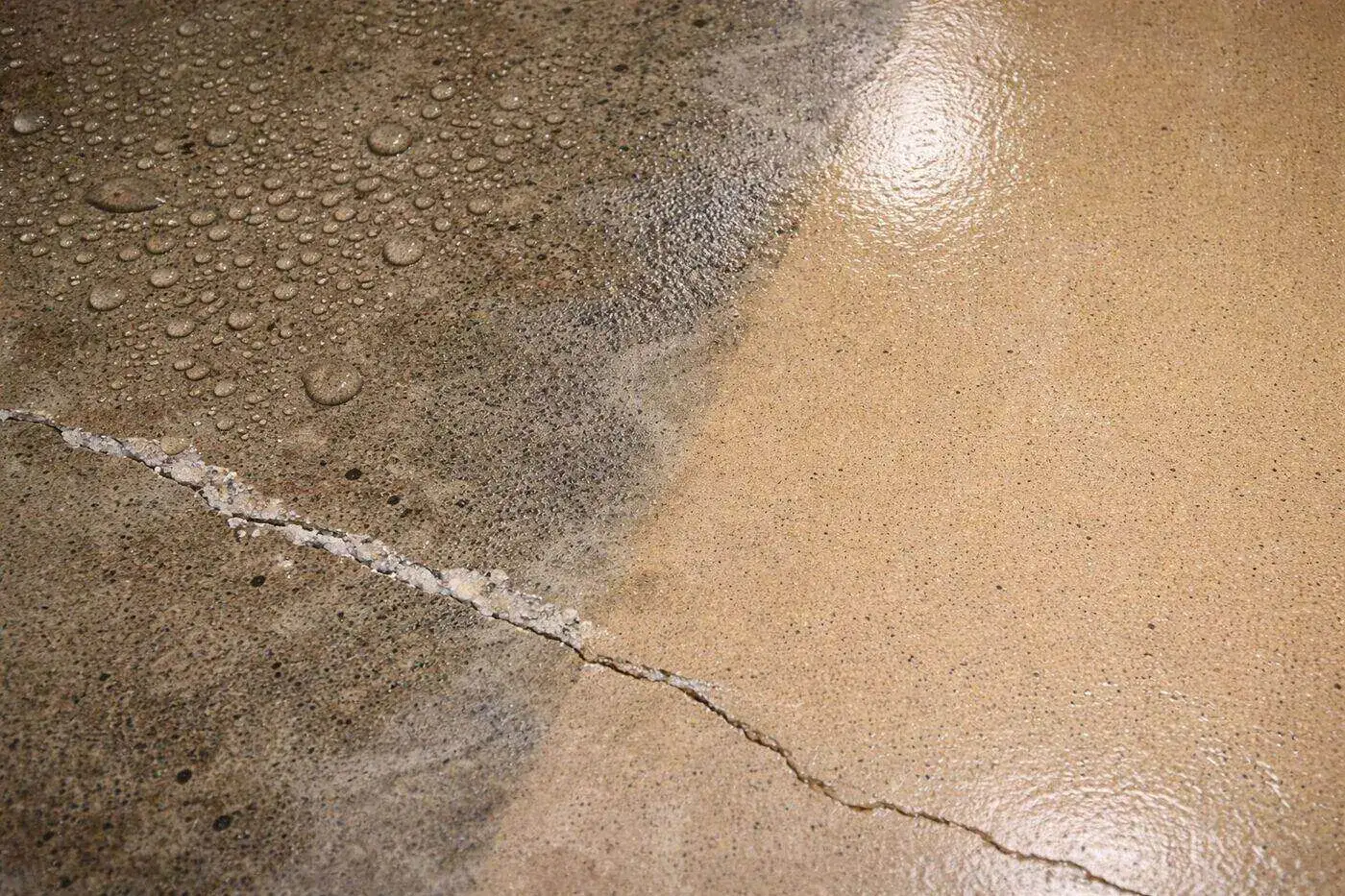
If there is one line on a Jacksonville quote you should never see missing, it is the moisture test. Sitting on a shallow coastal water table between the St. Johns River and the ocean, a large share of First Coast slabs wick groundwater vapor up through the concrete — and that vapor will lift a coating off the slab from below no matter how well the surface was prepped. A serious installer runs an ASTM moisture test before quoting; we include ours free, a test most companies quietly bill you for. If the reading comes back hot, a moisture-mitigation primer is no longer optional, and it becomes its own line on the quote. Omitting that primer to win a bid is the single most common reason epoxy floors bubble and delaminate in this part of Florida.
A Topcoat That Cures in the Humidity
Jacksonville spends most of the year humid and warm, and that wrecks the cure on bargain-bin epoxy — it blushes, clouds, or never fully hardens when it goes down in soupy air over a warm slab. That is exactly why we finish First Coast floors with polyaspartic and polyurea topcoats instead of slow-cure epoxy: they kick faster, tolerate the moisture in the air, and stay clear instead of ambering. That upgrade costs more than a basic epoxy topcoat on the same flake spec, but in this climate it is the line between a floor engineered for Northeast Florida and one that simply wasn't.
Sun That Yellows the Wrong Coating
Florida sun is brutal on any topcoat that is not UV-stable — it ambers and chalks the finish, and it works fastest on the strip of floor inside an open bay door or any room that catches direct afternoon light. The fix is to treat a UV-stable topcoat as the standard rather than an extra, which is precisely what a polyaspartic or polyurea system gives you. It nudges the entry spec above what a northern garage would tolerate, but it is the reason a Duval County floor still looks new a few summers later instead of looking sun-bleached.
Atlantic Salt Air
Properties out toward Jacksonville Beach, Atlantic Beach, Ponte Vedra, and up to Fernandina Beach catch a steady load of salt-laden air off the Atlantic, and over time that salt chews at coatings along edges and open bays. On a closed-up residential garage it is a minor concern; on an open-bay warehouse, a pool deck, or a waterfront home it is a real one, and the spec shifts toward thicker, more chemically resistant systems under that same UV-stable topcoat. The closer your project sits to the water, the more you should expect that to show up in the recommendation.
Put plainly: between the humidity, the shallow water table, the heat, and the salt, the correct system for a Jacksonville slab is rarely the cheapest one on the block. Those four drivers lift the floor on the entry price compared with a dry inland market — but they are also the exact reasons the finished floor lasts. For the full story on how slab moisture triggers failures and the test that heads them off, read our companion guide on why epoxy floors fail in Duval County and the moisture test that prevents it.
Which Finish Is Right for Your Project
The right finish is really a question of how the room gets used and what you want the floor to do for you. Match yourself to the case below and you will land close to the correct system before we ever walk your slab.
- You want it sealed, not styled: A solid color gives a workshop or storage bay a clean, sweepable, durable surface with none of the decorative premium.
- It's the family garage: Flake is the default Jacksonville pick, and deservedly so — it disguises marks, grips underfoot, and reads as finished. Topped with a polyaspartic, it is the best all-around value in Duval County.
- You want a room that turns heads: Metallic makes the floor the focal point. The premium is worth it precisely where appearance is the whole point.
- It has to survive abuse: Quartz is the toughest, grippiest system on the menu and the default for commercial kitchens, clinics, and wash-down rooms.
For the typical First Coast homeowner putting a floor in the garage, the answer lands in the same place almost every time: a full flake broadcast under a polyaspartic topcoat. It threads the needle between looks, durability, and the humidity-and-UV defense this climate quietly requires.
What a Real Quote Should Include
A price per square foot is meaningless if it quietly omits the work that keeps the floor stuck to the slab. Before you compare two Jacksonville estimates, make sure each one itemizes the same scope — otherwise you are comparing a complete floor to a coat of paint.
- An ASTM moisture test. On the First Coast this is non-negotiable, and a credible installer tests the slab before pricing it. If a company never brings it up, ask point-blank — and notice whether they charge for it.
- Diamond-grind prep. The floor should be mechanically ground open, not splashed with an acid wash. The quote should name the prep method in plain language.
- Crack and spall repair. Older Jacksonville slabs crack and chip; deep cracks need to be routed and filled before any resin goes down. Confirm it is in the scope, not an upcharge discovered mid-job.
- A complete coating system. Base coat, decorative layer, and a UV-stable polyaspartic or polyurethane topcoat — three components, not one thin flood coat masquerading as a system.
- An all-in total. Compare the bottom-line project price, because the per-foot number is exactly where the prep and topcoat get quietly deleted.
When one bid lands far below the rest, the gap is almost always something that got left out. The usual suspects: no moisture test, no real grinding, watered-down big-box product, and no protective topcoat. Those omissions feel like savings on signing day and cost you the entire floor a year or two later. A properly installed epoxy floor should give you 10 to 20 years in a home, which is why the prep you cannot see is the part that earns the price back several times over.
Frequently Asked Questions
How much does epoxy flooring cost in Duval County?
Every Duval County floor is priced after a free on-site visit, because the price depends on the size of the space, the condition of the slab (cracks, old coatings, moisture), the system and finish you choose (solid color, flake, metallic, or quartz), and the prep the concrete needs. Call (904) 441-5056 or request a free estimate to get an exact price, with no obligation.
Why is epoxy more expensive in Northeast Florida than the national average?
Because the slab itself is working against you here. A shallow coastal water table near the St. Johns River means many First Coast slabs need a moisture-mitigation primer, and the year-round humidity and sun force a UV-stable polyaspartic topcoat rather than bargain epoxy. Those are not upsells — they are what keeps the floor from peeling — so the Jacksonville entry price sits above what a dry inland market quotes.
How much does a 2-car garage epoxy floor cost in Duval County?
A standard Jacksonville two-car garage runs 400 to 500 square feet, and its price is set after a free on-site visit. A quality flake system covers the diamond grind, crack and spall repair, the base coat and the chip broadcast. A protective polyaspartic or polyurethane topcoat over that flake adds to the price, and a metallic finish adds more. Call (904) 441-5056 or request a free estimate to get an exact price, with no obligation.
Does my slab need moisture mitigation before epoxy?
There is a real chance it does. Sitting on a shallow coastal water table, plenty of Duval County slabs push enough vapor up through the concrete to lift a coating from below. The only way to know is to test, which is why we run a free ASTM moisture test before quoting. If the reading comes back above the safe threshold, a moisture-mitigation primer becomes mandatory rather than optional.
Which epoxy finish is the best value for a Duval County garage?
For most Jacksonville garages, a full flake broadcast under a polyaspartic topcoat is the clear value pick. It hides hot-tire marks and slab flaws, adds grip for a wet First Coast car, looks finished, and — most importantly here — carries the humidity and UV protection this climate demands.
How long should a professionally installed epoxy floor last in Duval County?
With a real diamond grind, moisture mitigation wherever the slab tests hot, and a UV-stable topcoat, expect roughly 10 to 20 years in a home and 5 to 10 years in a commercial space. The early failures people complain about almost always trace back to skipped prep in our humid, high-moisture climate — not to the coating technology itself.
Get Your Personalized Duval County Epoxy Quote
Knowing the cost drivers will get you close, but the only honest number is the one tied to your actual concrete. Every Ascent Epoxy Jacksonville estimate begins the same way: a real look at the slab, an ASTM moisture test, and a straight conversation about which finish fits your space and your budget. No high-pressure pitch, no figure that mysteriously balloons on install day — just a clear price and a system specified for the realities of a First Coast slab.
Ready for your number? Call (904) 441-5056 or request a free quote online. We coat floors across Mandarin, San Marco, Ponte Vedra Beach, Nocatee, Atlantic Beach, Orange Park, Fleming Island, Fernandina Beach, St. Augustine, and the neighborhoods throughout Duval County and the Greater Jacksonville metro.