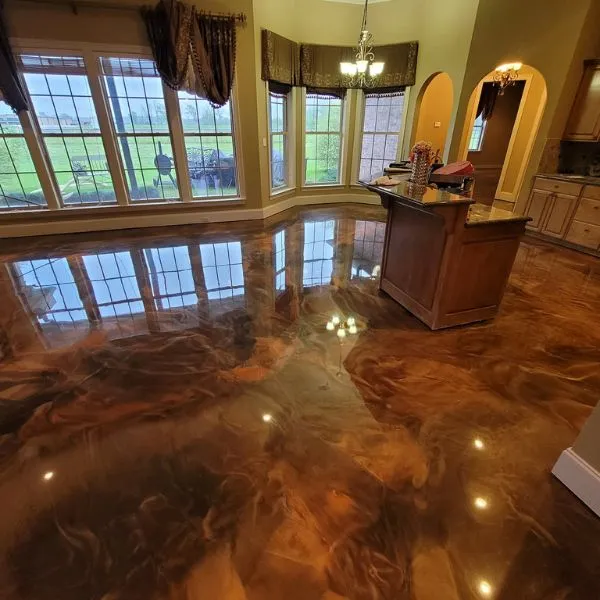
Metallic is the epoxy finish Jacksonville homeowners ask for by name — the flowing, liquid-marble look that turns a Riverside bungalow great room or a San Marco entry into something guests stop and study. It is one of four decorative families (alongside flake, quartz, and solid color), but in Northeast Florida the question that decides whether a metallic floor lasts is not the color you pick. It is whether the topcoat is built to take Atlantic salt air, a shallow coastal water table, and the kind of direct sun that fades a dock railing in two summers. Get the topcoat right and a metallic floor holds its depth for years; skip it and the same floor ambers and chalks by the second summer.
This guide leads with metallic, because along the First Coast it is the finish most design-minded owners are already picturing for a living space or showroom. From there it walks through flake, quartz, and solid color so you can see exactly where each one earns its keep — and the rule that decides which one survives our climate is the same every time: pick the style for the room, then lock the color in under a UV-stable polyaspartic or polyurea topcoat so the St. Johns sun does not bleach it.
Ascent Epoxy Jacksonville installs all four across Riverside, San Marco, Ponte Vedra Beach, Nocatee, Mandarin, Orange Park, the Beaches, and out to Fleming Island and St. Augustine. We do a lot of work on slabs that sit close to the river or the marsh, where the water table runs high and the air carries salt, so we steer every homeowner toward the system — and the topcoat — that actually fits that reality, not whatever looks good on a generic finish chart. Want a recommendation for your slab? Call (904) 441-5056 for a free estimate, or read on first.
Flake (Chip) Epoxy
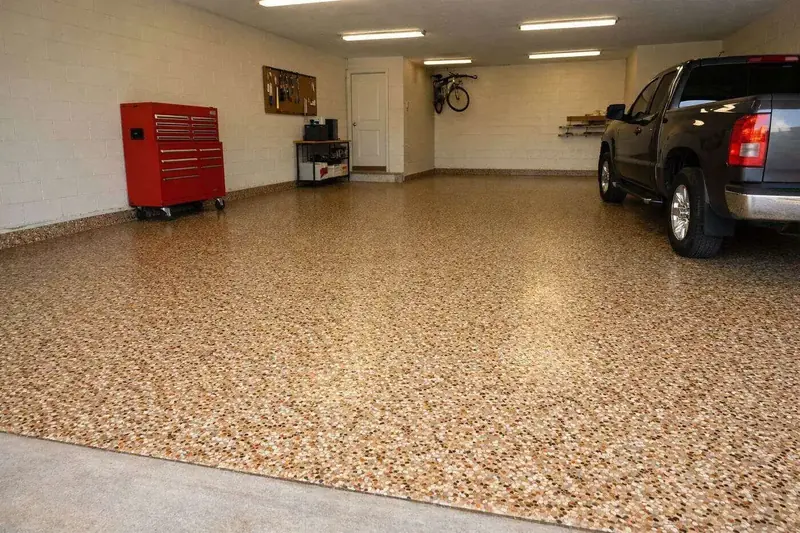
If metallic is the floor you show off, flake is the floor you live on. It is the everyday pick for Duval County garages, and around here it carries a practical edge that has nothing to do with looks: the speckled, multi-tone surface hides the sand and grit that get tracked in off the Beaches, and the built-up texture gives your feet something to grip when an afternoon storm blows rain in under a raised bay door. Vinyl color chips are scattered into the still-wet base coat by hand, then sealed under a clear topcoat, so the slab reads as a finished room rather than bare concrete.
The texture earns its keep in other ways too. It shrugs off the hot-tire pickup from a truck parked after an August run up I-95, it disguises the small surface flaws common in older Murray Hill and Avondale slabs, and it lets you hose the floor down without turning it into a skating rink. Color choice is wide open, from quiet coastal grays and sand tones that disappear into a clean garage to high-contrast blends with a fleck of teal or copper for owners who want the floor noticed. Dial the chip density up for full edge-to-edge coverage or keep it light to let the base tone show through, then seal it with a UV-stable polyaspartic and you have the best all-around value we install for this climate — a two-car garage in flake typically lands in the low-to-mid four figures here, well under the metallic premium.
Metallic Epoxy
This is the finish most readers came here for, so let us spend real time on it. A metallic floor starts as clear resin carrying a fine reflective pigment; the installer then chases that pigment across the slab while it is still moving, working it with rollers, a brush, and a quick pass of heat to open the surface so the color blooms into veins, ripples, and pools of depth. Cured, it can read like polished travertine, sun-on-the-river, or a slow swirl of molten metal — and because every pour is steered by hand in real time, the floor in your home will not exist anywhere else. There is no repeat pattern to match and no two pours alike. That is the appeal, and it is also why the installer's hand matters more on this finish than on any other.
For the taste we see around Jacksonville, metallic leans coastal and architectural. Owners along the river and the Intracoastal gravitate toward Atlantic blues and seafoam, oyster and sand neutrals that nod to the marsh, deep storm-grey pearls for a cleaner modern look, and warm copper or bronze for the brick-and-wood character you find in Riverside, Avondale, and San Marco. Because so many First Coast great rooms and entries are flooded with daylight and frame a river, marsh, or pool view, a marbled metallic floor stops being a coating and starts acting like a slab of imported stone. It is the natural pick for entryways, open living areas, home gyms, model homes, salons, and boutique retail anywhere the floor is meant to be admired rather than just walked across — and a showroom-style garage is a perfect home for it too.
In the Duval County market, metallic runs about $9 to $14 per square foot installed, and where you land in that range tracks the design, not the room: a single-color marble pour sits near the bottom, while a multi-pigment, multi-layer floor with deep, dramatic veining reaches the top. Two local notes are non-negotiable on a metallic install here. First, the standard metallic finish is glossy and slick, so for any space that can take water — an entry off the pool, a lanai, a beach-house mudroom — we blend a fine anti-slip aggregate into the topcoat. Second, and this is the one that protects your investment, that topcoat must be UV-stable, because nothing punishes a clear coat like Northeast Florida sun pouring through a wall of glass. More on that below, because for a metallic floor it is the whole ballgame.
Quartz Epoxy
Where metallic is about looks and flake is about value, quartz is about taking punishment. Instead of light vinyl chips, this system packs the resin with hard, graded quartz granules, building a floor that is noticeably thicker and denser underfoot. That body is what lets a quartz floor absorb dropped tools, rolling loads, and constant scrubbing without showing it, and the granular surface keeps its grip even soaked — the reason it is written into the spec for the commercial kitchens, clinics, restrooms, locker rooms, and food-prep areas across the Southside, Downtown, and the medical corridors near Baptist and UF Health. Where a health inspector or a wet-floor code is in play, quartz is the finish that answers it.
Quartz is not only commercial, though. As a premium residential option it earns its place in a busy laundry room, a boat-and-tackle workshop, or any space where durability and traction beat pure decoration — useful in a coastal household where salt, sand, and water come in the door daily. It can be tinted across a range of colors and blends, so it does not have to look industrial. Because a quartz system is specified by the job — the granule blend and the build thickness matched to how the room is used — expect it to be quoted after a walkthrough rather than priced off a list, generally at the upper end of the per-square-foot scale.
Solid Color Epoxy
Solid color is the clean, no-frills option — a single uniform color laid down as a smooth, glossy surface. No chips, no pigment movement, just an even coat that is easy to sweep, easy to mop, and easy on the budget. It is the natural pick for a utility garage, a storage room, a closet, or any space where the floor needs to be sealed and serviceable rather than eye-catching.
Because solid color skips the decorative media, it sits at the bottom of the price range — but it is the finish where skipping the prep hurts most, and in Northeast Florida the prep is the whole game. A solid coat shows every flaw, so it still needs a full diamond grind and crack repair, and on the low-lying slabs common from Mandarin down to the riverside and out toward the marsh, it needs a moisture-mitigation primer to survive the shallow water table pushing vapor up through the concrete. Skip that step and a glossy solid coat is the first finish to blister or peel. Do the prep right, pair it with a UV-stable topcoat, and a basic solid-color floor will outlast a big-box roll-on kit by years. It is the budget choice, not the corner-cutting choice.
Design Styles Compared
Here is how the four styles stack up at a glance for a Northeast Florida slab. Cost is per square foot installed in the Duval County market for 2026, and the durability and slip ratings are relative to one another within epoxy systems — all of them assuming the same baseline we hold to here: a full diamond-grind prep, moisture mitigation where the water table calls for it, and a UV-stable topcoat on top.
| Style | Look | Durability | Slip Resistance | Best Room | Cost / Sq Ft |
|---|---|---|---|---|---|
| Flake | Speckled, multi-tone, hides marks | High | Good | Garage | $6–$9 |
| Metallic | Marbled, glossy, 3D depth | High | Moderate | Living / showroom | $9–$14 |
| Quartz | Textured, granular, tintable | Highest | Highest | Kitchen / clinic | $10–$14 |
| Solid Color | Smooth, single-color gloss | Good | Moderate | Storage / utility | $5–$7 |
Picturing a Metallic Floor? Let's Talk Through It.
Tell us about your room, your view, and how the space gets used. We will recommend the right design style and topcoat for your slab and our coast, and give you a real number, free.
Choosing by Room
The fastest way to land on a style is to start with the room and how it earns its keep on the First Coast. Match the floor to the work it has to do — and to the salt, sand, and sun it has to survive — and the rest of the decision gets easy.
- Living areas, entries, and showrooms: Metallic. When the floor frames a river or marsh view and is meant to be admired, the hand-poured marble effect turns a slab into the centerpiece of a Riverside great room, a San Marco entry, a home gym, a salon, or a retail space.
- Garage: Flake is the default. It hides tire marks and the small flaws in older Duval slabs, adds grip for a rain-blown bay, and the broadcast blends match almost any home. With a UV-stable polyaspartic topcoat it is built for Northeast Florida garages.
- Kitchen, clinic, or laundry: Quartz. Where you need maximum durability and the best wet-floor grip for cleaning, spills, and heavy traffic, quartz is the safe, code-friendly choice — and the one health inspectors expect along the Southside and the hospital corridors.
- Storage and utility spaces: Solid color. For a workshop corner, storage room, or utility garage where function beats flair, a clean single-color floor seals and protects the slab at the lowest cost — provided the moisture prep is done.
- Pool deck, lanai, or beach-house entry: Flake or quartz, specified with an anti-slip additive and a UV-stable topcoat. Sun-soaked, wet-foot surfaces near the coast need both traction underfoot and protection from the sun, so the spec leans hard toward grip and UV stability.
If a single space pulls double duty, lean toward the more demanding use. A garage that also serves as a gym or hangout, for example, still does best on flake, since it has to handle cars and a wet bay door first. And any room that opens to the pool or the dock gets the anti-slip topcoat regardless of the style on the floor.
Colors & Keeping Them True in the Florida Sun
Color is the fun part, and every style here offers plenty of it. Flake comes in dozens of ready-made blends, metallic can be mixed to almost any custom tone with real depth, quartz can be tinted from soft neutrals to bright safety colors, and solid color covers the full palette. But picking a color is only half the job on the First Coast. The other half is making sure that color still looks right a few Florida summers from now.
Here is the catch our climate adds, and it is the whole reason a metallic floor lives or dies on its topcoat. Northeast Florida sun is strong and year-round, and the same raw UV that fades a dock railing or a boat seat in two seasons ambers and chalks any clear coat that is not UV-stable — faster than most homeowners expect, and worst of all right behind the wall of glass in a river-view great room. A floor finished with a basic, non-UV-stable topcoat yellows, dulls, and loses its depth, and that punishes metallic hardest, because depth and shine are the entire point of it. The fix is simple and non-negotiable here: a UV-stable polyaspartic or polyurea topcoat over whatever style you choose. It locks the pigment, resists yellowing, and keeps the color reading true. On the coast, factor the salt air in too — that same topcoat is what seals the surface against the salt that rides in on the sea breeze.
This matters most on sun-flooded interiors with big windows and on open garages where the bay door stays up and the afternoon sun lands straight on the slab. If you want to understand why the topcoat choice drives so much of a floor's lifespan here, our guide on epoxy vs. polyaspartic breaks down the difference, and our cost guide shows how that topcoat upgrade fits into the overall price by finish.
Frequently Asked Questions
Will a metallic floor fade in the Jacksonville sun?
Only if it is sealed with the wrong topcoat. The same Northeast Florida sun that bleaches a dock railing in two seasons will amber and chalk any clear coat that is not UV-stable, and that hits a metallic floor hardest because depth and shine are its whole appeal. Finish it with a UV-stable polyaspartic or polyurea topcoat and the color holds true for years. It matters most behind the big windows of a river-view great room and in open garages where the bay door stays up.
How much does a metallic epoxy floor cost in Duval County?
Metallic runs about $9 to $14 per square foot installed in the Duval County market, versus roughly $6 to $9 for flake. You pay more because the reflective pigment is worked by hand during the pour to create a one-of-a-kind marbled effect, and that skilled labor drives the price. A single-color marble pour sits near the bottom of the range; a multi-pigment, multi-layer floor with deep veining reaches the top. Flake is the better value for a working garage; metallic is the designer showpiece.
What metallic colors work best for a First Coast home?
Around Jacksonville, owners lean coastal and architectural: Atlantic blues and seafoam, oyster and sand neutrals that nod to the marsh, deep storm-grey pearls for a modern look, and warm copper or bronze that plays off the brick and wood you find in Riverside, Avondale, and San Marco. Because so many First Coast great rooms frame a river, marsh, or pool view in daylight, a marbled metallic floor reads like a slab of imported stone. Any custom tone can be mixed, so the color follows the room.
Is a metallic floor slippery, and can it go near the pool?
A standard metallic finish is glossy and slick, so for any space that takes water — a pool-side entry, a lanai, a beach-house mudroom — we blend a fine anti-slip aggregate into the topcoat. That keeps the marbled look while giving wet feet something to grab. For a fully wet, hard-use area like a commercial kitchen, quartz is the more slip-resistant system; for a living space that occasionally sees water, metallic with the anti-slip topcoat is the right call.
Does the high water table near the river affect a metallic floor?
It can, which is why prep matters as much as the pour here. On the low-lying slabs common from Mandarin to the riverside and out toward the marsh, the shallow coastal water table pushes moisture vapor up through the concrete, and that vapor is what makes a coating blister or peel. We free-test the slab with an ASTM moisture reading and, where the numbers call for it, install a moisture-mitigation primer before the metallic base coat. Get that right and the floor stays bonded for the long haul.
When should I choose flake or quartz instead of metallic?
Choose flake when the floor has to work for a living — a Duval County garage, where the speckled surface hides tire marks and tracked-in sand, adds grip for a rain-blown bay, and costs less. Choose quartz when the room takes a beating or stays wet, like a commercial kitchen, clinic, or laundry, where its thick granular surface gives the best wet-floor traction. Metallic is the pick when the floor is meant to be seen and admired rather than just walked across.
Get Your Personalized Duval County Epoxy Quote
The best way to choose a design style is to see samples in your own space, in your own light, and talk through how you will use the room. At Ascent Epoxy Jacksonville, every estimate starts with a real look at your slab, a free ASTM moisture test where the water table calls for it, and an honest recommendation on which style, color, and topcoat make sense for your space, your budget, and the First Coast climate. No pressure and no bait-and-switch — just a clear plan and a floor engineered for Northeast Florida salt air, sun, and slab moisture.
Ready to start? Call us at (904) 441-5056 or request a free quote online. We serve Ponte Vedra Beach, Nocatee, Atlantic Beach, Mandarin, Orange Park, Fleming Island, Fernandina Beach, St. Augustine, Jacksonville Beach, San Marco, and the surrounding communities across Duval County.
Related Articles
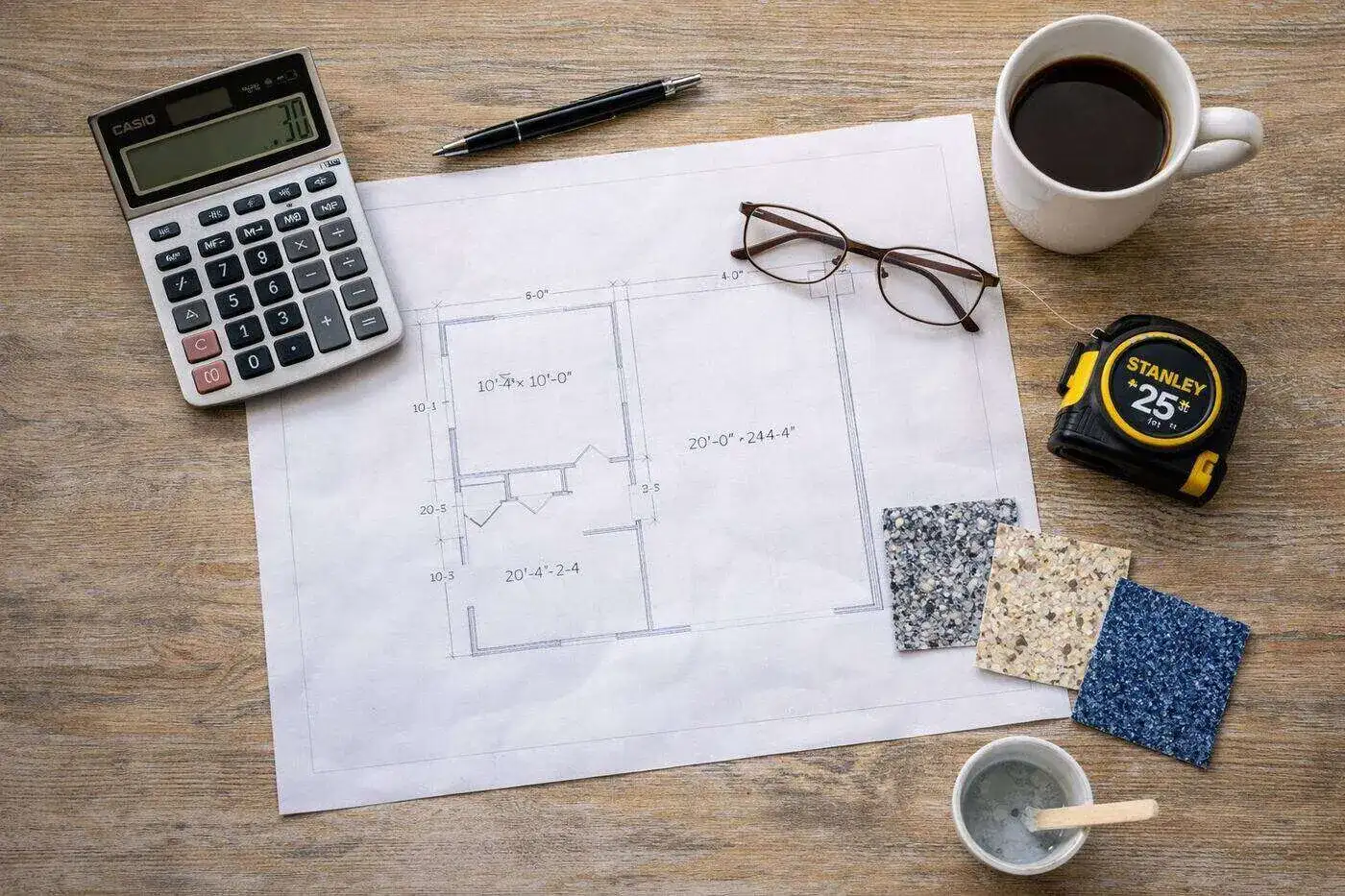
How Much Does Epoxy Flooring Cost in Duval County? (2026 Guide)
Real prices by finish and a typical 2-car garage total.
Epoxy vs. Polyaspartic: Which Is Better for a Duval County Floor?
Cure time, UV, humidity, and why the durable local floor uses both.
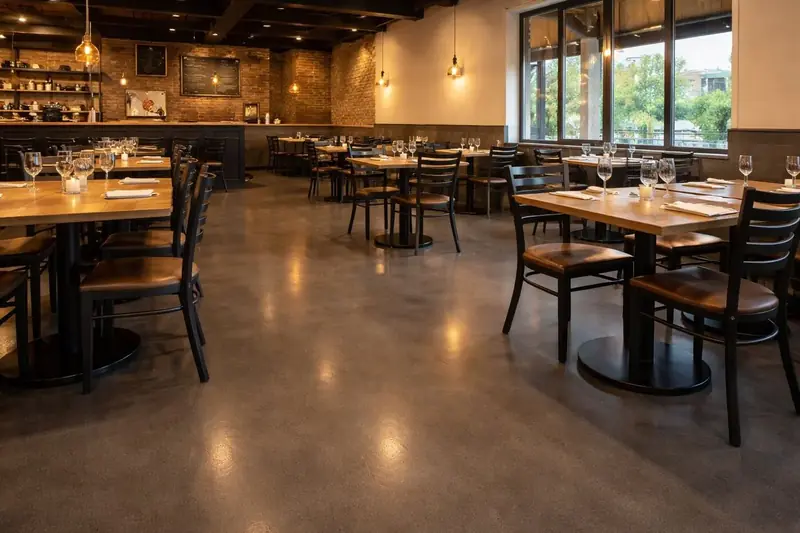
Commercial Epoxy Flooring in Duval County
Seamless, sanitary, slip-rated floors by industry.